
Cell engineering
Engineering Microbial Protein Synthesis and Secretion
A central challenge in microbial cell engineering is the inherent trade‑off between host growth and the production of engineered proteins. Synthetic circuits and their host cells draw from the same limited pool of cellular resources-enzymes, substrates, and energy-leading to reduced performance on both sides. This concept of cellular capacity has become a key constraint in modern synthetic biology.
One promising strategy to overcome this limitation is the creation of orthogonal protein synthesis systems that operate alongside native translation machinery without competing for the same substrates. Eszter Csibra’s group develops an innovative platform based on tethered ribosomal RNAs, which assemble into orthogonal ribosomes dedicated exclusively to synthetic circuit expression (Csibra et al., 2023). This work aims not only to improve the efficiency of engineered protein production, but also to provide a powerful in situ tool for probing the dynamics of microbial translation.
Protein secretion presents a complementary opportunity to reduce intracellular burden and simplify downstream purification of recombinant products. Yet, secretion pathways are themselves subject to resource bottlenecks and stress responses, limiting yields. Building on advances in resource‑responsive genetic circuits, the Csibra lab is developing auto‑regulatory systems tailored for secreted proteins, enabling engineered cells to sense and adapt to secretion‑associated stress. By coupling secretion demand with responsive feedback control, these systems aim to stabilize production and enhance overall efficiency.
Quantitative Biology of Fluorescence
The Design–Build–Test–Learn cycle in synthetic biology relies on rapid and reliable screening of engineered variants, and fluorescence remains the most versatile readout for this purpose. It is sensitive across a wide dynamic range, compatible with bulk and single‑cell analysis, and does not require cell disruption. Yet typical fluorescence measurements provide only relative signals, making it difficult to extract biologically meaningful information such as absolute protein abundance.
To address this, the Csibra group develops quantitative methods that convert fluorescence data into absolute molecular units, such as protein copy number per cell. They introduced a simple and robust calibration strategy for multiwell plate assays (Csibra and Stan, 2022), released alongside the open-source FPCountR software, enabling researchers to perform accurate fluorescence quantification with standard laboratory equipment. Ongoing work extends these approaches through new computational tools (Csibra and Stan, 2023), broadening the applicability of quantitative fluorescence in synthetic and microbial cell biology.
De Novo Protein Design for Signalling and Synthetic Circuits
Advances in large‑scale machine‑learning models, such as AlphaFold, have transformed protein science by enabling accurate prediction of three‑dimensional structures directly from amino‑acid sequence. The Bayliss lab also applies these tools to dissect the molecular mechanisms of dynamic protein–protein interactions involved in protein signalling pathways (Figure 1) (Miles et al., 2026). Building on this structural capability, it is now possible to design de novo proteins with tailored shapes and binding surfaces that engage specific targets with high affinity and precision.
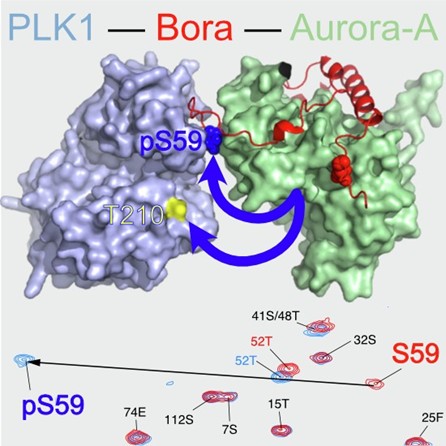
Figure 1. Structural models show how Bora bridges Aurora-A and PLK1, activating Aurora-A and orienting it for PLK1 phosphorylation. Bora forms phosphorylation-enhanced interfaces on both kinases that resemble the Aurora-A/TPX2 complex, revealing a shared structural mechanism and highlighting opportunities for inhibitor design (Miles et al., 2026).
Research groups in Leeds are leveraging this capability to engineer programmable binders that modulate cellular signalling pathways. By designing proteins that selectively recognise signalling enzymes and their regulatory partners, the lab is developing new ways to perturb, redirect, or reconstitute signalling flows inside living cells. These designer molecules offer a modular toolkit for constructing synthetic signalling circuits and for precision control of disease‑relevant pathways.
Key references:
Csibra E., Stan G.-B.; Absolute protein quantification using fluorescence measurements with FPCountR. Nature Communications 13, 6600 (2022).
Csibra E., Stan G.-B.; Parsley: a web app for parsing data from plate readers. Bioinformatics 39, (12) (2023).
Csibra E., Klopproggeet B., et al.; Engineering orthogonal ribosomes for real-time monitoring using fluorescence. (2023).
Miles J.A., Batchelor M., Walko M., et al.; Bora bridges Aurora-A activation and substrate recognition of PLK1. EMBO Reports 27, 993–1022 (2026).