
Membrane protein technologies
SMALPs: detergent-free membrane protein-handling
Membrane proteins require amphiphilic liquid crystalline solvation to be stable in aqueous media. Commonly, detergents are used for in vitro membrane protein handling, but these can also have a detrimental impact on their stability. We have expertise in detergent-free methods that utilise amphiphilic copolymers, such as styrene maleic acid (SMA) and amphipol-based polymers, to extract and process membrane proteins (Figure 1). These copolymers are often referred to as “cookie-cutter” polymers as they extract the membrane proteins with an annulus of native lipid to form SMA-stabilised lipid nanoparticles (SMALPs). In addition to improved stability and function it provides a platform for lipidomic analysis which is becoming more important with the growing literature around the role of lipids in protein function and regulation. This work has involved several industrial partners over its development including MedImmune, GlaxoSmithKline and UCBPharma. Leeds is also one of the leading partners in the recently established IMPALA BBSRC-funded network to broaden the use of this approach within both industry and academia.
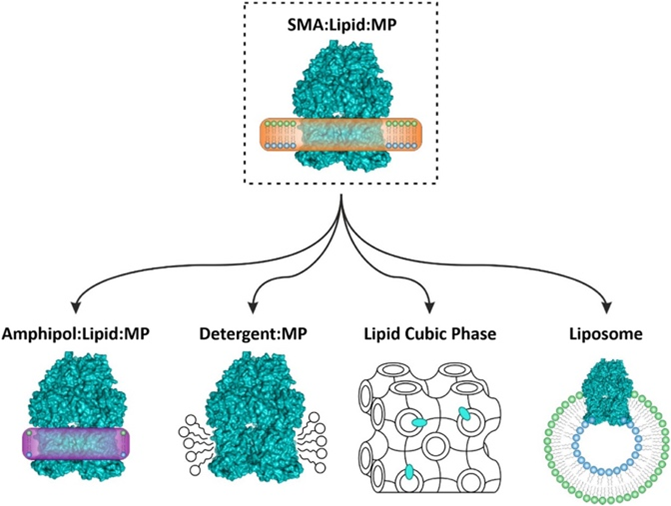
Figure 1. SAMLPs as a vehicle for transfer into downstream platforms.
Schematic highlighting the versatility for SMA to reconstitute into downstream platforms including amphipol, detergents, LCP and liposomes.
Key references:
Higgins A.J., Flynn A.J., Marconnet A., et al.; Cycloalkane-modified amphiphilic polymers provide direct extraction of membrane proteins for CryoEM analysis. Communications Biology 4, 1337 (2021).
Hesketh S.J., Klebl D.P., Higgins A.J., et al.; Styrene maleic-acid lipid particles (SMALPs) into detergent or amphipols: An exchange protocol for membrane protein characterisation. Biochimica et Biophysica Acta (BBA) - Biomembranes 1862 (5), 183192 (2020).
Pollock N.L., Rai M., Simon K.S., et al.; SMA-PAGE: A new method to examine complexes of membrane proteins using SMALP nano-encapsulation and native gel electrophoresis. Biochimica et Biophysica Acta (BBA) - Biomembranes 1861 (8), 1437-1445 (2019).
Hybrid vesicles: enhanced durability for enhanced functional lifetime
We have developed novel vesicle formulations to solve the challenge of poor long-term storage stability and membrane protein function in in vitro lipid vesicle systems. Hybrid vesicles have been developed that combine phospholipids with synthetic block copolymers. The lipids provide natural biocompatibility for the membrane proteins, while the block copolymers add stability and mechanical robustness to the vesicle membranes. We have demonstrated that the bacterial respiratory enzyme, cytochrome bo3, exhibits an order-of-magnitude improvement in functional lifetime in hybrid vesicles compared to liposomes (Figure 2).
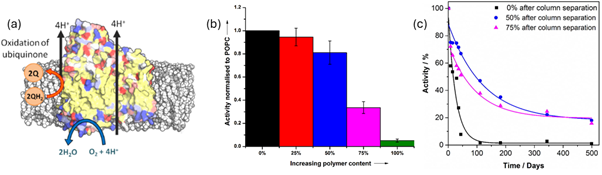
Figure 2. Enhanced functional lifetime of membrane proteins in hybrid vesicles. (a) Schematic of the structure and function of cytochrome bo3, a redox-active proton pump. (b) The initial reconstitution activity of cytochrome bo3 when reconstituted into hybrid vesicles with increasing block copolymer content (0% to 100% polymer). Activity comparable to liposomes (0% polymer) is achieved for polymer compositions up to 50 mol%. (c) The enzyme activity of hybrid vesicles stored at 4 °C decays more slowly for hybrid vesicles compared to liposomes, with >20% of the initial enzyme activity retained after 500 days.
Hybrid vesicles have other advantages too. Their membranes have significantly lower passive permeability to solutes, e.g. protons. Hybrid lipid-polymer membranes also have greater elasticity than lipid membranes, which enables a wider range of approaches to membrane protein insertion: we have demonstrated membrane protein reconstitution from SMALPs into hybrid vesicles, which was not successful for lipid vesicles. We are also developing methods for direct membrane protein insertion into hybrid vesicles using cell-free protein expression systems (see below).
Key references:
Khan S., Li M., Muench S.P., Jeuken L.J.C. and Beales P.A.; Durable Proteo-Hybrid Vesicles for the Extended Functional Lifetime of Membrane Proteins in Bionanotechnology. Chemical Communications 52, 11020 - 11023 (2016).
Seneviratne R., Khan S., Moscrop E., et al.; A reconstitution method for integral membrane proteins in hybrid lipid-polymer vesicles for enhanced functional durability. Methods 147, 142 - 149 (2018).
Rottet S., Iqbal S., Beales P.A., et al.; Characterisation of Hybrid Polymersome Vesicles Containing the Efflux Pumps NaAtm1 or P-Glycoprotein. Polymers 12(5), 1049 (2020).
Catania R., Machin J., Rappolt M., et al.; Detergent-Free Functionalisation of Hybrid Vesicles with Membrane Proteins Using SMALPs. Macromolecules 55(9), 3415–3422 (2022).
Cell-free membrane protein synthesis
A significant bottleneck in membrane protein production has been in the production of high yields of purified, stable and functional protein. This is especially pertinent for those membrane proteins whose overexpression results in cell death such as constitutively open ion channels and Receptor Tyrosine Kinases (RTKs). We have recently shown how cell free platforms can be used to successfully overexpress these challenging systems. Moreover, combining cell-free membrane protein expression with highly durable hybrid vesicles has the potential to revolutionise workflows for production and screening of membrane protein assay systems in the pharmaceutical industry.
Key reference:
Snow A.J.D., Wijesiriwardena T., Lane B.J., et al.; Cell-free expression and SMA copolymer encapsulation of a functional receptor tyrosine kinase disease variant, FGFR3-TACC3. Scientific Reports 15, 2958 (2025).
Artificial photosynthesis: biomembranes with tuned optical properties
Light-harvesting proteins from plants are optimized to absorb solar energy with high efficiency but their spectral range is limited by their natural combination of pigments. We have designed and produced artificial biomembranes where the absorbing range of these proteins are greatly enhanced by dye molecules that transfer energy to the protein with high efficiency. To do this, small organic dye molecules that absorb light at alternative wavelengths were assembled into lipid vesicles with light-absorbing proteins from plants or bacteria. We observed high efficiency energy transfer and over 200% enhancement of the absorption strength of the protein (Figure 3).

Figure 3. Energy transfer between dyes and plant proteins. The schematic shows a lipid bilayer (black/ white), a dye linked to a lipid headgroup (red) and a Light Harvesting membrane protein (green). The blue arrow represents Förster Resonance Energy Transfer (FRET) from the dye to the protein. The graph on the left shows fluorescence spectra of a series of membrane samples where the protein concentration was increased, causing the dye’s peak at 610 nm to decrease. The graph on the right shows fluorescence spectra of a series of membrane samples where the dye concentration was increased, causing the protein’s peak at 685 nm to increase.
Most recently, we have generated photovoltaic devices that have improved performance due to a combination of light-harvesting proteins and dyes within model lipid membranes. We are also exploring the use of amphiphilic polymers as a replacement for lipids to stabilize these light-absorbing proteins. Finally, we have assembled quantum dots and lipids together into stable nanoscale clusters which transfer energy interchangeably. Overall, we hope that providing new insights into artificial photosynthetic membranes and related nanomaterials will provide valuable clues for future solar technologies.
Key references:
Hancock A.M., Meredith S.A., Connell S.D., et al.; Proteoliposomes as energy transferring nanomaterials. Nanoscale 11, 16284-16292 (2019).
Meredith S.A., Yoneda T., Hancock A.M., et al.; Model lipid membranes assembled from natural plant thylakoids into 2D microarray patterns as a platform to assess the organization and photophysics of light-harvesting proteins. Small 17, 2006608 (2021).
Hancock A.M., Swainsbury D.J.K., Meredith S.A., et al.; Enhancing the spectral range of plant and bacterial light-harvesting pigment-protein complexes with various synthetic chromophores incorporated into lipid vesicles. Journal of Photochemistry and Photobiology B: Biology 237, 112585 (2022).
Kondo M., Hancock A.M., Kuwabara H., et al.; Photocurrent Generation by Plant Light-Harvesting Complexes is Enhanced by Lipid-Linked Chromophores in a Self-Assembled Lipid Membrane. Journal of Physical Chemistry B 129, 900-910 (2025).