
Molecular pattern recognition on cells and in tissues
The ability to identify and selectively target specific cell types or tissue states within mixed populations has been fundamental to advances in cell biology and medicine. This is typically achieved by targeting receptors that are present on the desired cells or tissues but absent from others. In practice, antibodies or similar ligands are used to recognise receptors with high affinity and specificity in a one-to-one manner.
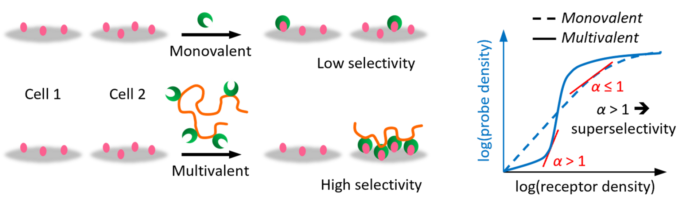
However, this well-established approach fails when both target and background cells express the same receptor at different concentrations. In such cases, high selectivity cannot be achieved with individual ligands alone. Instead, multivalent probes are required to enable “superselective” recognition of receptor concentrations above a defined threshold. Cells themselves often use this form of pattern recognition to sense and communicate with their environment, and pathogens such as viruses similarly rely on multivalent binding to identify host cells.
Inspired by these natural systems, we engineer superselective probes: programmable, multivalent biomolecular sensors that use modular design and nonlinear binding behaviour to distinguish target biomarkers above a defined concentration threshold. Our focus is on glycans, whose expression on cell surfaces and within the extracellular matrix is known to change in diseases such as cancer, infections, and inflammatory conditions. These properties make glycans an emerging class of biomarkers that require superselective targeting.
Key reference:
Dubacheva G.V., Curk T., Richter R.P.; Determinants of superselectivity - Practical concepts for application in biology and medicine. Acc Chem Res 56, 729-739 (2023).