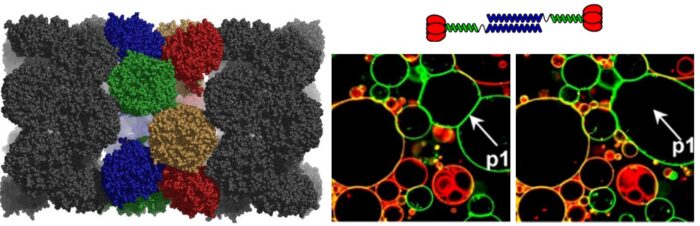
Controlled protein modification is a critical technique for engineering biological systems. By deliberately introducing targeted modifications we are able to precisely control protein function, imbue them with new function and control their spatial and temporal localisation. This level of control is essential if we are to be able to replicate and adapt biological function or to design new functions. Researchers at Leeds have a long history of such targeted protein modification to understand function and behaviour and a small subset of such approaches are described below.
Controlled modification of native proteins
Protein can be routinely labelled chemically and enzymatically via modification of both natural amino-acid residues and unnatural amino-acids introduced via metabolite or amber suppression for example to generate multivalent inhibitors (McBerny et al., 2022) or to understand protein-protein assemblies with temporal resolution (Cahill et al., 2025). Such approaches are now being adapted further to identify reagents which can selectively modify proteins in the cell and thereby modulate function (Chesti et al., 2026a; Chesti et al., 2026b). Alternatively, enzymes which recognise and modify particular peptide sequences have been engineered and adapted to enable very high-efficiency labelling of proteins for applications throughout biology (Arnott et al., 2024).
Imbuing new function
Engineering proteins with new function and assembly can be achieved via both computational and experimental means. Researchers at the university have demonstrated the efficacy of both approaches. For example, they have demonstrated the success of computational approaches in the design of membrane-spanning proteins (Vorobieva et al., 2021; Berhanu et al., 2024). In other work, existing proteins have been imbued with new function and activity. Addition of simple coiled-coil recognition motifs enables some proteins to self-assemble into higher-order assemblies (Ross et al., 2019) but also enables others to act as catalysts for membrane fusion and rearrangement (Dai et al., 2026; Wehrum et al., 2022).
Key references:
Arnott Z.L.P., Morgan H.E., Hollingsworth K., et al.; Quantitative N- or C-Terminal Labelling of Proteins with Unactivated Peptides by Use of Sortases and a d-Aminopeptidase. Angew. Chem. Int. Ed., 63, e202310862 (2024).
Berhanu S., Majumder S., Müntener T., et al.; Sculpting conducting nanopore size and shape through de novo protein design. Science 385, Issue 6706, pp. 282-288 (2024).
Cahill A., Walko M., Fenton B., et al.; Design and characterisation of photoactivatable and lysine reactive o-nitrobenzyl alcohol-based crosslinkers. Chem. Sci., 16, 15239-15255 (2025).
Chesti J., Miles J.A., Wade G.J., et al.; Modular Rh-Catalyzed Synthesis and Biological Profiling of Diverse Pentafluorobenzenesulfonamide Reactive Fragments. Chemistry - A European Journal: e00009 (2026a).
Chesti J., Miles J.A., Collins L.J., et al.; High-throughput discovery and characterisation of pentafluorobenzene sulfonamide modifiers of Aurora A kinase. RSC Chem. Biol., 7, 862-869 (2026b).
Dai W., Kempmann E., Rosato F., et al.; Engineered Coiled-Coils Convert Cholera Toxin B-Pentamers into Programmable Membrane Fusogens. ACS Nano, 20, 20, 14645–14658 (2026).
McBerney R., Dolan J.P., Cawood E.E., Webb M.E., Turnbull W.B.; Bioorthogonal, Bifunctional Linker for Engineering Synthetic Glycoproteins. JACS Au 2022, 2, 9, 2038–2047 (2022).
Ross J.F., Wildsmith G.C., Johnson M., et al.; Directed Assembly of Homopentameric Cholera Toxin B-Subunit Proteins into Higher-Order Structures Using Coiled-Coil Appendages. J. Am. Chem. Soc. 141, 13, 5211–5219 (2019).
Vorobieva A.A., White P., Liang B., et al.; De novo design of transmembrane β barrels. Science 371, Issue 6531 (2021).
Wehrum S., Siukstaite L., Williamson D.J., et al.; Membrane Fusion Mediated by Non-covalent Binding of Re-engineered Cholera Toxin Assemblies to Glycolipids. ACS Synth. Biol., 11, 12, 3929–3938 (2022).