
Protein scaffolds
Engineering all-enzyme biomaterials
There are major challenges in exploiting enzymes in biomaterials, including their loss of enzyme activity after immobilisation, mass-transfer limitations, uncontrolled enzyme orientation, low stability over time and limited reusability or regeneration. Such challenges matter because they limit the potential to exploit enzymes in industrial biocatalysis, biosensing platforms and enzyme-based smart materials.
One promising strategy to overcome these limitations is the creation of all-enzyme networks, self-assembled, water-rich gels composed entirely of enzymes that have been engineered to crosslink with each other. Instead of embedding enzymes inside a polymer matrix, the enzymes are both the matrix and the catalytic nanomachines. Lorna Dougan’s group have developed a platform for creating all-enzyme biomaterials using a facile photoactivated chemical cross-linking approach (Laurent et al. 2025). The materials have tuneable mechanical, structural architecture and biological function (Figure 1).
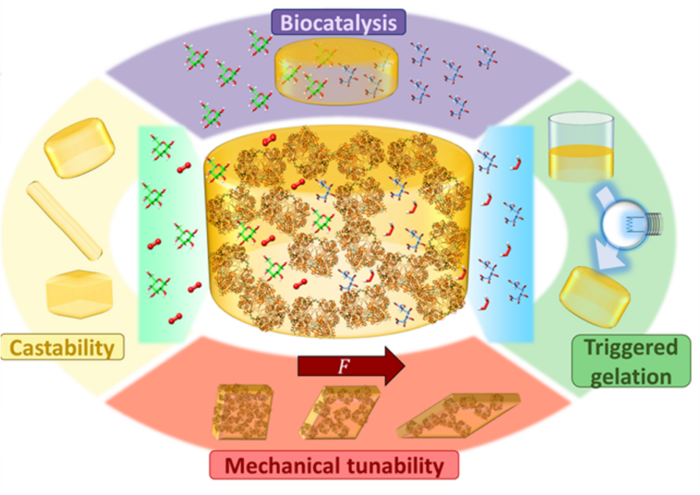
Figure 1. All-enzyme biomaterials offer promise for highly efficient catalytic density, versatility for multi-enzyme cascades, scaffolds for continuous-flow manufacturing.
Key reference:
Laurent H., Brockwell D.J., and Dougan L.; Nanomachine Networks: Functional All-Enzyme Hydrogels from Photochemical Cross-Linking of Glucose Oxidase. Biomacromolecules 26, 2, 1195-1206 (2025).
Engineering living matrices
The convergence of engineering, biology and materials science is providing unprecedented opportunities to integrate living cells into soft materials. This integration yields ‘engineered living matrices’ with the capabilities of self-replication, self-regulation and environmental responsiveness. However, several challenges need to be overcome to unleash the full potential of engineered living biomaterials in real-world applications. An expansion of the synthetic toolkit and fabrication methods is required for the routine production of living biomaterials and a deeper examination of the design principles used in their production.
Matrices, also known as hydrogels, are ideal environments for cells due to their biocompatibility, chemical permeability, and a range of mechanical properties such as specific swelling and elastic and viscoelastic properties. Their high water content (70-99% vol %) hydrates the encapsulated living cells, while the cross-linked network provides structural integrity (Figure 2). However, these natural matrices have high batch-to-batch variability, and their properties are difficult to predictably modulate. Conversely, simple synthetic alternatives, such as peptides, exhibit limited biological functionality. A synthetic and functional building block toolkit is urgently needed to have the dual advantage of pre-defined/designed matrix properties (stiffness, viscoelasticity, porous structure) and biological functionality (cellular attachment and differentiation).
We are developing engineering design cycles to create dynamic matrices for controlling cell responses. Our approach is to build cross-linked matrices whose structural and mechanical properties can be rationally tailored using engineered protein components to act as scaffolds and to functionally respond. The matrix design achieves time-dependent and predictable matrix mechanical properties, by exploiting tuneable chemical cross-linking kinetics and the time-dependent relaxation of the synthetic proteins.

Figure 2. Engineering living matrices from folded (red) and unfolded (white) proteins is an exciting frontier in engineering biology.
Proteins are used as the structural building blocks and engineered to form cross-linked networks that can assembly, disassembly and behave like living matter.
Key references:
Hughes M.D.G., Cook K.R., Cussons S.E., et al.; Capturing the impact of protein unfolding on the dynamic assembly of protein networks, Soft Matter 21, 1748-1759 (2025).
Hughes M.D.G., West D., Wurr R., et al.; Competition between cross-linking and force-induced local conformational changes determines the structure and mechanics of labile protein networks, Journal of Colloid and Interface Science 678, 1259 (2025).
Hughes M.D.G., Cook K.R., Cussons S.E., et al.; Capturing dynamic assembly of nanoscale proteins during network formation, Small, 21, 2407090 (2025).
Hughes M.D.G., Cussons S., Hanson B.S., et al.; Building block aspect ratio controls assembly, architecture, and mechanics of synthetic and natural protein networks. Nature Communications 14, 5593 (2023).
Aufderhorst-Roberts A., Cussons S., Brockwell D.J., and Dougan L.; Diversity of viscoelastic properties of an engineered muscle-inspired protein hydrogel, Soft Matter 19, 3167 (2023).